
-1753444735.png)

Why India's Hidden Gems Are Worth Seeking Out
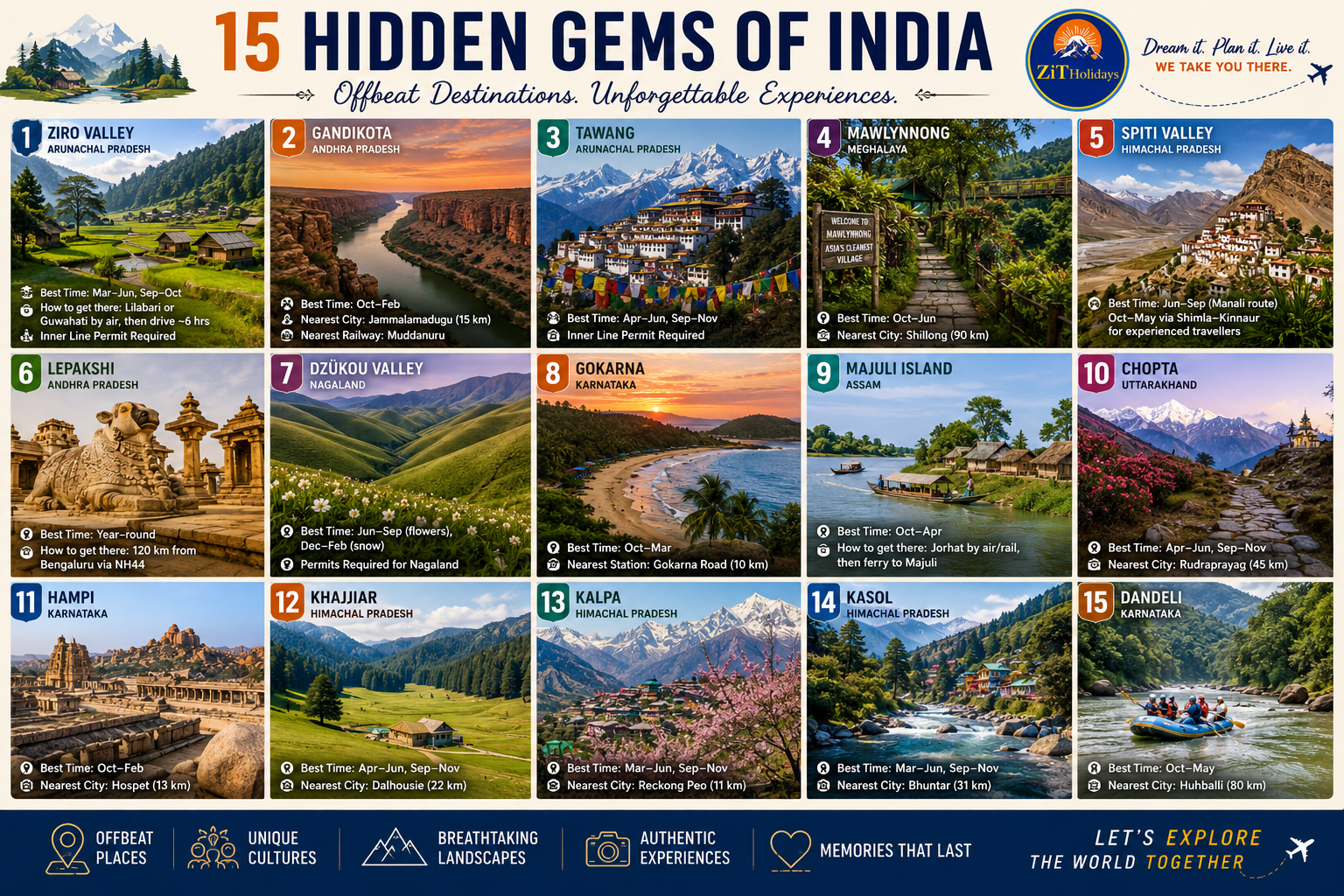
India gets 20+ million tourists a year — and almost all of them funnel into the same ten postcards: the Taj Mahal, Jaipur's Pink City, Goa's beaches, Kerala's backwaters. These are magnificent, no argument there. But if you're the kind of traveller who wants to be the first to discover a misty valley or a 900-year-old stepwell with no queue, India's hidden gems are waiting for you.
This guide uncovers 15 unexplored and offbeat destinations in India that rarely appear on mainstream itineraries — spanning the Himalayas, the Deccan Plateau, the Northeast frontier, and the forgotten coastlines. Each entry tells you what makes it special, the best time to visit, and how to get there.
1. Ziro Valley, Arunachal Pradesh — India's Best-Kept Himalayan Secret
Tucked inside a UNESCO World Heritage tentative-list site in the northeastern state of Arunachal Pradesh, Ziro Valley is a breathtaking plateau carpeted with pine forests, terraced rice paddies, and the mud-and-bamboo villages of the Apatani tribe.
Unlike Manali or Shimla, Ziro sees a fraction of the footfall — yet it offers arguably richer cultural immersion. The annual Ziro Music Festival (September) draws indie artists and a small, passionate crowd that feels worlds away from commercial music events.
Best time to visit: March–June and September–October
How to get there: Fly to Lilabari (North Lakhimpur) or Guwahati, then drive ~6 hours
Inner Line Permit required: Yes (obtainable online or at Arunachal Pradesh House)
2. Gandikota, Andhra Pradesh — India's Own Grand Canyon
Standing on the edge of Gandikota feels like someone airlifted a piece of the American Southwest into South India. The Penna River has carved a dramatic gorge through the Erramala Hills, and perched right on its lip is a ruined 13th-century fort — roofless, largely unrestored, and almost entirely tourist-free.
Sunrise here rivals anything in Rajasthan. Bring a sleeping bag: the Andhra Pradesh Tourism guesthouses let you camp inside the fort premises for under ₹1,500 a night.
Best time to visit: October–February
Nearest city: Jammalamadugu (~15 km); closest railway station is Muddanuru
3. Tawang, Arunachal Pradesh — A Monastery Town Above the Clouds
Yes, Tawang is growing in popularity — but it remains dramatically undervisited compared to its Tibetan cultural equivalents in Ladakh. At 10,000 feet, the Tawang Monastery is the largest Buddhist monastery in India and the second-largest in the world, radiating a serenity that Leh has long since lost to selfie sticks and Instagram queues.
Beyond the monastery, the Sela Pass (13,700 ft) and the pristine Madhuri Lake (named after the Bollywood actress who filmed a song here) make the journey feel genuinely cinematic.
Best time to visit: April–June and September–November
Inner Line Permit required: Yes
4. Mawlynnong, Meghalaya — Asia's Cleanest Village
Mawlynnong earned the title "Asia's Cleanest Village" in 2003 and has quietly kept the reputation ever since. The village runs on community-driven waste management, and the streets are spotless in a way that challenges everything you think you know about Indian rural tourism.
What elevates Mawlynnong beyond a novelty tag is its living root bridges (natural suspension bridges formed by training Ficus roots across streams) and the panoramic view of the Bangladesh plains from a 90-foot bamboo skywalk.
Best time to visit: October–June (avoid monsoon travel unless you love leeches)
Nearest city: Shillong (~90 km)
5. Spiti Valley, Himachal Pradesh — The Middle Land
Spiti sits in a cold desert between India and Tibet, higher than most mountain passes and quieter than Ladakh by an order of magnitude. The Key Monastery (13,668 ft) perches on a hilltop above a valley that looks like a film set for a post-apocalyptic drama — barren, magnificent, and achingly silent.
The villages of Langza, Hikkim (home to the world's highest post office), and Komic (world's highest motorable village) offer homestay experiences that put you directly inside Spitian life.
Best time to visit: June–September (road via Manali); October–May only via Shimla–Kinnaur route for experienced travellers
6. Lepakshi, Andhra Pradesh — The Temple That Defies Gravity
Two hours north of Bengaluru, Lepakshi is one of South India's most spectacular Vijayanagara-era temple complexes — and almost no one outside the region knows it exists. The Veerabhadra Temple houses 70 intricately carved pillars, ceiling frescoes that have survived 500 years without restoration, and — most famously — a hanging pillar that demonstrably does not touch the ground.
The site also contains what's claimed to be India's largest Nandi (sacred bull) sculpture, carved from a single granite boulder.
Best time to visit: Year-round; avoid midday heat October–March
How to get there: 120 km from Bengaluru via NH44
7. Dzükou Valley, Nagaland — The Valley of Flowers You've Never Heard Of
Himachal Pradesh's Valley of Flowers is on every bucket list. Dzükou Valley on the Nagaland–Manipur border is its wilder, lonelier twin. The valley blooms with the rare Dzükou lily in July–August, and the 4-hour trek from Viswema village climbs through bamboo thickets into an otherworldly landscape of rolling green hills and mist.
Basic camping facilities and bamboo huts are available inside the valley. Infrastructure is minimal — which is exactly the point.
Best time to visit: June–September for flowers; December–February for snow
Permits: Required for entry into Nagaland; obtainable at Dimapur or Kohima
8. Gokarna, Karnataka — Goa Before Goa Got Complicated
Gokarna is what Goa was in 1990: quiet coves, a functioning temple town, and beaches you can have almost to yourself. Om Beach, named for its distinctive shape when viewed from the cliffs, draws a low-key mix of yogis, budget backpackers, and families escaping the Goa circus.
The town itself is a working Hindu pilgrimage site centred around the Mahabaleshwara Temple, giving it a spiritual gravity that purely tourist-oriented beach towns can't replicate.
Best time to visit: October–March
How to get there: Nearest station is Gokarna Road; 2 hours from Goa by road
9. Chettinad, Tamil Nadu — The Forgotten Palace Trail
Chettinad is a cluster of towns in Tamil Nadu that 19th-century merchant princes filled with extraordinary mansions — hundreds of rooms, Italian marble floors, Belgian glass, Burmese teak — and then largely abandoned when the spice trade collapsed. Walking through Karaikudi or Kanadukathan today feels like exploring a decaying dreamscape.
The region is also the source of Chettinad cuisine, considered among the spiciest and most complex in India. Several mansions have been converted into heritage guesthouses where you eat under chandeliers in rooms with crumbling grandeur.
Best time to visit: October–February
Nearest airport: Madurai (~90 km)
10. Majuli, Assam — The World's Largest River Island (Shrinking Fast)
Majuli is a genuinely endangered wonder. The world's largest inhabited freshwater river island — in the middle of the Brahmaputra — has lost more than half its area to erosion in 50 years. That ticking clock makes a visit feel urgent and poignant.
The island is home to Vaishnavite satras (monasteries), a living tradition of mask-making, dance, and theatre that was integral to the 15th-century Bhakti reform movement. It is, in the truest sense, a culture that may not exist in another generation.
Best time to visit: October–March
How to get there: Ferry from Jorhat; fly to Jorhat from Guwahati or Kolkata
11. Khimsar, Rajasthan — Dunes Without the Crowds
Every India itinerary points at Jaisalmer for desert sunsets. Khimsar, 90 km from Jodhpur, offers the same sweeping Thar Desert dunes — with a medieval fort-hotel on the edge of a sand sea — and none of the camel-safari tourist conveyor belt. The Khimsar Fort has been a royal guesthouse since the 16th century and remains one of Rajasthan's most atmospheric stays.
Best time to visit: October–February
How to get there: 90 km from Jodhpur on NH62
12. Munsiyari, Uttarakhand — The Last Village Before Tibet
Known locally as "Chhoti Kashmir," Munsiyari sits at the base of the Panchchuli peaks and is the gateway to the Milam and Ralam glaciers — some of the highest and most remote treks in India. Unlike Mussoorie or Nainital, it has no mall road, no toy train, and no crowds.
The drive from Pithoragarh alone — through rhododendron forests, past hanging villages, beside glacial rivers — is the kind of experience that makes you feel like a proper explorer.
Best time to visit: April–June and September–November
13. Dholavira, Gujarat — An Indus Valley City Lost to Time
Most tourists in Gujarat go to Rann of Kutch. Dholavira — now a UNESCO World Heritage Site (since 2021) — sits in the same district yet receives a tiny fraction of visitors. This 4,500-year-old city of the Harappan civilisation is one of the most significant and best-preserved archaeological sites in South Asia.
The scale is astonishing: multi-tiered fortifications, a sophisticated water harvesting system, and a stadium-like structure that suggests spectacle and ceremony — all from a civilisation that predates the Roman Empire by 2,000 years.
Best time to visit: October–February
How to get there: Bhuj is the nearest city (~250 km); hire a car
14. Haflong, Assam — India's Only Hill Station in Assam
The Northeast is full of surprises, and Haflong — the only designated hill station in Assam — is one of the most pleasant. Perched above the Haflong Lake, the town is home to Dimasa and Zeme Naga tribal communities and sees almost no international tourists.
The surrounding North Cachar Hills offer trekking, birdwatching (over 300 species recorded), and a pace of life so unhurried it feels therapeutic.
Best time to visit: October–April
How to get there: Train from Guwahati to Mahur or Haflong Road station
15. Velas Beach, Maharashtra — Where Olive Ridley Turtles Nest
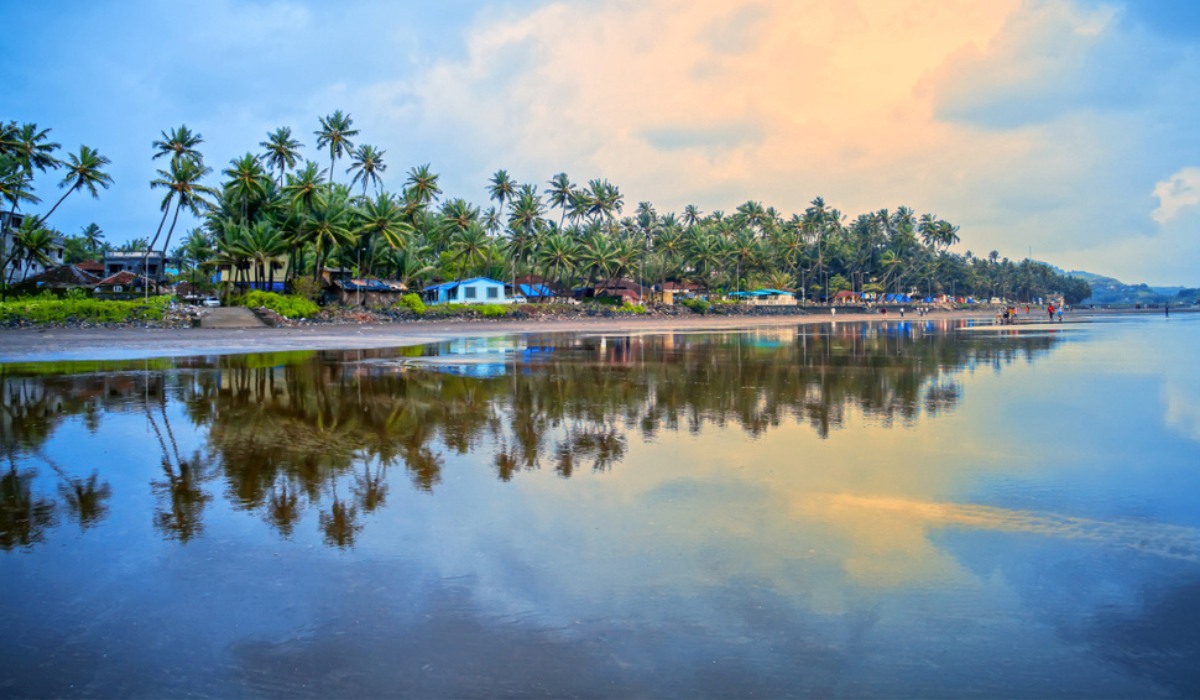
From February to April, Velas — a tiny fishing village on the Konkan coast — hosts one of India's few community-run turtle conservation festivals. Olive Ridley sea turtle hatchlings emerge from beach nests and make their way to the Arabian Sea, with villagers standing guard against poachers.
The Kasav Mahotsav (Turtle Festival) is coordinated by local NGOs and the forest department. There are no five-star hotels, no Instagram hotspots — just one of nature's most moving annual events.
Best time to visit: February–March for turtles; October–May for general visits
How to get there: ~200 km from Mumbai via Pune–Kolad route.
Frequently Asked Questions About Hidden Gems in India
What are the most underrated places to visit in India?
Some of the most underrated destinations include Ziro Valley (Arunachal Pradesh), Gandikota (Andhra Pradesh), Chettinad (Tamil Nadu), and Majuli (Assam). These places offer rich cultural, historical, or natural experiences comparable to mainstream tourist destinations but with a fraction of the crowds.
Which hidden gems in India are best for solo travellers?
Gokarna (Karnataka), Munsiyari (Uttarakhand), and Spiti Valley (Himachal Pradesh) are excellent solo destinations, with established homestay cultures, safe environments, and strong backpacker infrastructure. For northeast India, joining a guided group is advisable given the permit requirements.
Do you need permits to visit hidden gems in Northeast India?
Yes. Most states in Northeast India — including Arunachal Pradesh and Nagaland — require an Inner Line Permit (ILP) for Indian citizens and a Protected Area Permit (PAP) for foreign nationals. These are obtainable online or at designated government offices and are usually processed within 24–48 hours.
What is the best time to visit offbeat places in India?
October to March is generally the best window for most of India's hidden gems, covering pleasant weather across Rajasthan, South India, and the Deccan. The Northeast and Himalayan destinations have specific seasonal windows (April–June and September–November) due to monsoon and snowfall patterns.
Are hidden gem destinations in India budget-friendly?
Most offbeat destinations in India are significantly cheaper than mainstream tourist circuits. Homestays, local dhabas, and government guesthouses keep costs low. Spiti Valley, Ziro, and Majuli in particular are excellent value — expect to spend ₹800–1,500/night for accommodation at quality homestays.
Conclusion: Go Before Everyone Else Does
India's hidden gems are extraordinary precisely because they haven't been homogenised by mass tourism. The monastery with no queue, the beach with no sun-lounger vendors, the ancient city with no selfie sticks — they still exist. But the window is narrowing.
The best time to visit any of these offbeat places in India is, almost always, right now — before the roads improve, before the Instagram algorithms catch on, and before your favourite solitary sunrise becomes a scheduled photo op.
Pack a spirit of curiosity, a flexible itinerary, and respect for local communities. India's most unexplored destinations will give you more than any postcard ever promised.
Comment (0)
Leave A Comment: